Link Building Prospecting: How to Find Sites That Will Actually Link to You

500 qualified prospects produce about 8 links. Here is the qualification bar, the search operators, the 60-second filter and the funnel math behind that number.

Link building prospecting is the work of finding and qualifying the specific websites that have a real reason to link to a page you own, before any outreach email gets written. It is list building with a filter on it. You start from a seed (a competitor's backlink profile, a search query, a mention of your brand) and you end with a spreadsheet of sites, pages and named humans where each row carries a one-line answer to "why would this person link to this?"
Here is the argument this guide makes: your prospect list is the campaign. Almost every failed link building push gets diagnosed as a copywriting problem. The reply rate was 2%, so the team rewrites the template, tests a new subject line, adds a joke. It rarely helps, because the email was never the constraint. You emailed people who were never going to link, and no template saves a list like that. Relevance is decided in the prospecting stage and everything downstream just inherits it.
The corollary is uglier. Bad prospecting shows up as a low reply rate, and the industry's standard response to a low reply rate is to send more. So a list that was too loose gets three times bigger, quality drops again, the domain reputation takes the hit, and now you have a deliverability problem stacked on top of a relevance problem. Volume is a coping mechanism for a list you did not qualify.
tl;dr:
- Prospecting is the highest-leverage stage in link building. A tight list of 80 genuinely relevant sites beats a scraped list of 3,000.
- A qualified prospect needs three things: topical overlap, a specific page your link would improve, and a reachable human who can edit that page.
- The best sources are competitor backlink gaps, unlinked brand mentions, broken links on relevant pages, resource and roundup pages, and people who already write about your topic.
- Google search operators still do most of the finding. Paid tools speed it up, they do not replace the judgment.
- Do the funnel math before you start. Published reply rates land in the high single digits to low teens (Backlinko and Pitchbox, 12 million outreach emails, 2019: 8.5%; Respona, 37,000+ link pitches: about 10%, roughly half of them negative). A list of 100 is not a campaign, it is a rounding error.
- Prospecting is slow, repetitive, judgment-heavy work, which is exactly what makes it worth handing to an agent.
Why Your Prospect List Is the Campaign#
Two numbers explain why this stage matters more than the writing. Ahrefs' crawl of over a billion pages found that 66.31% of pages have no backlinks at all, and 90.63% get zero organic traffic from Google. Those two facts sit next to each other for a reason. Meanwhile Backlinko's analysis of one million Google results (2020) found the number one result has, on average, 3.8x more backlinks than positions two through ten. These studies predate 2026 and the exact percentages have moved, but the shape has held every time anyone re-runs them: links decide who gets seen.
So you need links, and the way you get them is that you ask. That ask is the outreach half of getting more backlinks, and this guide is about the stage that comes before it. The quality of that ask is capped by who you are asking. Think about the two ends of the range. On one end, you email a site that has published three articles on your exact subtopic in the last six months, one of which references a stat you have a better version of, and you email the person whose byline is on it. On the other end, you email info@ at a general business blog because a tool said their domain rating was 62. Same template. Wildly different outcomes. The email did not change. The prospect did.
That is why the money is in filtering, not in finding. Finding sites is easy and getting easier. Deciding which twelve of the two hundred you found are worth a personalized email is the actual skill.
What Makes a Good Link Prospect#
A prospect qualifies when three things are true at once. Miss one and the row should not be on your list.
Topical overlap. The site publishes about your subject, not about your subject's grandparent category. A site about B2B SaaS marketing is not automatically relevant to your page on database indexing. Ask whether a reader of their content would click your link. If the honest answer is "some of them, maybe", cut it.
A specific target page. Not "this site should link to us" but "this URL, in this paragraph, would be better with our link in it." If you cannot name the page and the sentence, you do not have a prospect, you have a domain. This is the single most common gap between a list that converts and a list that does not, and it is also what makes the email write itself later.
A reachable human with edit rights. Somebody who can actually change that page and whose email you can find and verify. A general contact form on a 400-person media company is not a prospect. The freelancer who wrote the piece and still updates it is.
Everything else (domain rating, traffic estimates, referring domain counts) is a tiebreaker, not a gate. Authority metrics are the easiest thing to sort by, which is precisely why sorting by them alone produces the same list everyone else is emailing.
Where Link Prospects Actually Come From#
There are maybe eight sources that produce most real links. They differ enormously in effort and in what they yield.
| Source | How you find it | Effort | Typical link quality | Best for |
|---|---|---|---|---|
| Competitor backlink gaps | Pull competitors' referring domains, subtract your own | Low | High, proven willingness to link | Any site with real competitors |
| Unlinked brand mentions | Search your brand and product names, filter out linked results | Low | High, easiest yes in link building | Brands with any press or community presence |
| Broken links on relevant pages | Crawl topical resource pages for 404s you can replace | Medium | Medium to high | Niches with old, well-linked resource pages |
| Resource and "best of" pages | Search operators for curated link lists | Medium | Medium, sometimes editorially thin | Tools, templates, calculators, guides |
| Recent writers on your topic | Find bylines from the last 6 months on the subtopic | Medium | High, they are actively covering it | Anything with an active publishing scene |
| Original data and research assets | Pitch to people who cite statistics in your niche | High | Highest, and it compounds | Teams that can produce a real dataset |
| Podcasts and interviews | Find shows covering your category, pitch a guest angle | High | Medium, but builds relationships | Founders and operators with a story |
| Communities and niche directories | Category-specific listings, newsletters, curated hubs | Low | Low to medium, but fast | Early stage, thin profiles |
The pattern worth noticing: the low-effort sources are all built on someone having already demonstrated intent. They linked to a competitor. They mentioned you. They curated a list. Prospecting is cheapest when you are finding people who have already shown you they link.
The Prospecting Plays, With the Actual Queries#
Search operators still do most of the finding, and they cost nothing. Replace the bracketed parts.
Resource and links pages in your niche:
[topic] intitle:"resources" -inurl:jobs
[topic] inurl:links OR inurl:resources "useful links"
[topic] intitle:"best" intitle:"tools" 2026
Sites that publish contributed content:
[topic] "write for us"
[topic] "contribute to" OR "guest post guidelines"
[topic] "become a contributor" -inurl:jobs
Roundups and curated lists that get updated:
[topic] "roundup" intitle:"weekly" OR intitle:"monthly"
[topic] "we recommend" OR "our favorite tools"
Unlinked mentions of your brand:
"[your brand]" -site:[yourdomain.com]
"[your product name]" -site:[yourdomain.com] -site:twitter.com
Statistic-hungry pages, if you have original data:
[topic] "according to a study"
[topic] statistics 2026 -site:[yourdomain.com]
Run each of these, take the first five pages of results, and dump them into a sheet. That is your raw list. The raw list is not the prospect list. Now you filter.
Paid tools compress the grunt work here. A backlink index gets you competitor referring domains in seconds, a crawler flags dead links in bulk, an email finder guesses the address pattern. None of them decide relevance for you, which is why an expensive stack and an unqualified list is such a common combination.
How to Qualify a Prospect in 60 Seconds#
Open the target page. Not the homepage, the page you want the link on. Then run this.
| Check | Keep it if | Cut it if |
|---|---|---|
| Topic match | The page covers your exact subtopic | It is a general category page or an unrelated vertical |
| Editorial life | Published or updated in the last 18 months | Last touched in 2019, comments closed |
| Outbound links | It links out to other sites in the body | Zero external links anywhere on the site |
| Link context | You can point to the sentence your link belongs in | You are hoping they will "find a spot" |
| Human | A named author, editor or small team is findable | Only a contact form behind a 300-person masthead |
| Intent honesty | You would send this link to a friend reading the page | You are rationalizing the fit |
If you cannot name the URL and the sentence your link belongs in, you do not have a prospect. You have a domain.
Six checks, about a minute per prospect once you have the rhythm. Expect to cut 60% to 80% of a raw list. That is the process working, not failing. If you are keeping most of what you found, your seed queries were too narrow or your standards are too loose.
Write the reason to link into the row while the page is open. One line, plain language: "Their 'best onboarding tools' post lists eight, none of which do X, our page covers X." That sentence is the raw material for the email later, and capturing it during qualification is the difference between outreach that takes four minutes a send and outreach that takes twenty.
How to Find the Right Human#
A named person beats a generic inbox on every metric that matters. The order of preference is simple: the author of the target page, then the editor of that section, then whoever owns content for the site, then the general inbox as a last resort.
Practical route: check the byline and the author page, check the site's about and team pages, check LinkedIn for the content or SEO role, then infer the email pattern from any known address at the domain (first@, first.last@, f.last@ cover most of it) and verify it before sending. Verification is not optional. Bounces are the fastest way to torch a sending domain, and if you want the full picture on how that plays out, we wrote it up in why cold emails go to spam.
Personalization then does the rest of the work. Backlinko and Pitchbox's analysis of 12 million outreach emails (2019) found that emails with a personalized message body had a 32.7% better response rate, and personalized subject lines lifted responses by 30.5%. That lift is only available to you if the prospect row contains something real to personalize with, which loops back to qualification. Personalization that actually works is downstream of prospecting, always.
How Many Prospects Do You Actually Need?#
Do this math before you start, not after you are disappointed. Two independent datasets bracket the reply rate. Backlinko and Pitchbox's analysis of 12 million outreach emails (2019) found an average response rate of 8.5%. More recently, Respona's benchmark across more than 37,000 link pitches put the average reply rate at roughly 10%, with about half of those replies negative. The older study and the newer one agree on the shape: high single digits to low teens, and most replies are not a yes. Here is a conservative model built on the lower number.
| Stage | Conversion | Starting from 500 qualified prospects |
|---|---|---|
| Contact found and verified | 80% | 400 sends |
| Reply (any kind) | 8.5% (Backlinko; Respona measured ~10%) | 34 replies |
| Positive reply | 40% of replies (Respona: ~50%) | 14 interested |
| Link actually goes live | 60% of positives | 8 links |
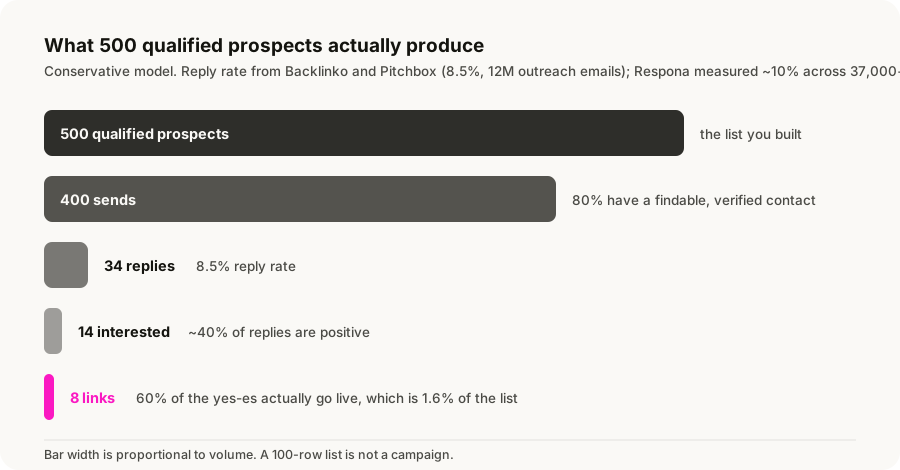
Eight links from 500 qualified prospects. That is roughly what a competent month looks like, and it is why a 100-row list is not a campaign. Two levers move that output: raise reply rate through relevance and personalization, or raise the number of relevant sends. Most teams try to raise sends without holding relevance constant, which drops the reply rate and nets out flat or worse.
The follow-up sits inside that reply number, not on top of it. The same study found a sequence of emails got roughly double the responses of a single send, and the mechanics of that are covered in our follow-up strategy guide.
That top-of-funnel number is the part almost nobody sustains by hand. Building, qualifying and contact-finding 500 rows a month, every month, is the exact grind GenSend's backlink agent was built to absorb. See it run on your niche.
A Worked Example#
Say you run SEO for a project management tool for construction firms. Seed query:
"project management software" construction intitle:"best" 2026
Raw list: 60 URLs from the first five result pages. Now filter. Twenty-two are affiliate farms with no editorial contact, cut. Nine are your direct competitors' own comparison pages, cut. Six last updated in 2021, cut. That leaves 23.
Of those 23, you can name the exact insertion point on 14: they are all listicles that name six to ten tools and none of them include a construction-specific option, or they include one that shut down last year. Those 14 are your prospects.
Now the humans. Eleven have bylines, seven of those authors have findable addresses. Four are freelancers who have written multiple pieces in the category, which makes them a relationship, not a one-off send. The reason-to-link line for one row reads: "Their roundup lists ten tools, three are now dead links, and none handle subcontractor scheduling, which is the thing their readers are searching for."
That single sentence is a better email than any template. And you can only write it because you looked at the page during qualification.
Where This Gets Harder Than It Sounds#
Two honest caveats. First, this is slow, and the industry's own numbers say so. Aira's State of Link Building report, a survey of 270 SEOs across agencies, in-house teams and freelancers, found 32% of link builders spend one to two hours per link earned and another 24% spend three to five hours. Sixty seconds per prospect is the number after you are practiced, and it excludes finding and verifying the contact. Building 500 genuinely qualified prospects with named humans is multiple days of focused work, every month, forever. The reason most in-house link building stalls is not that the method is unknown, it is that nobody has three uninterrupted days a month.
Second, qualification is judgment, and judgment drifts. Under quota pressure the bar moves. Rows you would have cut in week one survive in week three because the list is short and the deadline is not. Nothing in a tool stops that. The only real defenses are a written qualification standard you apply the same way every time, and separating the person building the list from the pressure to hit a send count.
The Prospecting Mistakes That Kill Campaigns#
- Sorting by domain rating and calling it a list. Authority is a tiebreaker between relevant options, not a substitute for relevance.
- Domain-level prospects with no target page. If you cannot name the URL and the paragraph, you will write a vague email and get a vague non-answer.
- Emailing generic inboxes at scale. It reads as bulk, it usually is bulk, and nobody there owns the page.
- Skipping verification. Bounces damage the sending domain that your whole program depends on.
- Reusing one list across months. Re-pitching the same non-responders with the same angle is the fastest way to get filtered permanently.
- Treating the list as a data problem. Scraping is the easy half. The reason-to-link line is the half that produces links.
Where GenSend Fits#
GenSend is a backlink agent, and prospecting is the part of the job it is built for, because it is the part that is mostly grind. It runs the seed queries and the competitor gap pulls, filters the raw list against the qualification bar, finds and verifies the named contact rather than defaulting to the generic inbox, and writes the personalized pitch off something specific it read on the target page. Then it sends and follows up.
What it is not: a shortcut around relevance. It does not conjure prospects that do not exist in your niche, and it will not make a bad target page linkable. What it does is enforce the structure, on every row, at a volume no person sustains by hand, so the standard you set in week one is still the standard in week twelve.
Once your list is built, the emailing half is covered in link building outreach. If your emails are the weak link rather than your list, start with how to write cold emails that get replies.
Frequently Asked Questions#
What is link building prospecting?
Link building prospecting is the process of finding and qualifying websites that have a genuine reason to link to a specific page of yours, and identifying the person there who can add that link. It comes before outreach and determines how well outreach performs. The output is a list where every row names a target URL, a contact, and a one-line reason the link makes sense.
How is link prospecting different from link building outreach?
Prospecting is finding and qualifying who to email. Outreach is the emailing itself: the pitch, the follow-ups, the negotiation. They are two stages of the same pipeline, and prospecting sets the ceiling for what outreach can achieve, because no email converts a prospect who had no reason to link.
How many link prospects do I need per month?
Work backwards from your link target. Reply rates published by Backlinko and Pitchbox (8.5% across 12 million emails) and Respona (about 10% across 37,000+ link pitches, half of them negative) put you in the same place: after drop-off from reply to positive reply to live link, roughly 500 qualified prospects tends to produce single-digit links. If you need twenty links a month, you need a prospecting operation, not a spreadsheet you top up occasionally.
What are the best free link prospecting tools?
Google search operators do most of the finding for free, and they are still the backbone of every method in this guide. Free tiers of backlink indexes and a browser extension that shows outbound links get you surprisingly far. Paid tools compress time, they do not replace the qualification judgment, which is the part that actually decides results.
Should I prospect by domain rating?
Use it as a tiebreaker, never as the filter. A relevant site at DR 30 whose readers are your buyers will send you traffic and rank signal that a DR 80 general business blog will not, and the DR 80 site is being emailed by everyone. Filter on relevance and a specific target page first, then sort what survives by authority.
Can link building prospecting be automated?
The mechanical parts, yes: pulling competitor backlinks, running seed queries, deduplicating, checking freshness, finding and verifying contacts. The judgment part is where automation usually fails, because most tools stop at "found a domain" instead of "found a page this link improves." An agent that carries the qualification standard through to the pitch is the version worth having, and that is the job GenSend is built to do.